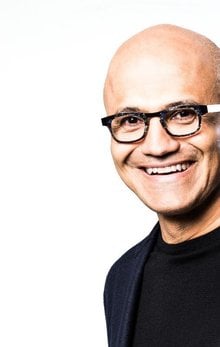
Microsoft’s New Growth Era: Inside Satya Nadella’s AI Vision

Satya Nadella’s leadership at Microsoft continues to define the company’s trajectory in an era dominated by AI.
In his 2025 annual letter to shareholders, Satya emphasised a strategy of “thinking in decades, executing in quarters”, a balance between long-term vision and near-term results that has become a hallmark of his tenure.
At the heart of Microsoft’s growth strategy is the company’s embrace of the AI platform shift.
Discussing this transformation, Satya says: “More than any transformation before it, this generation of AI is radically changing every layer of the tech stack, and we are changing with it.”

Financially, the results speak volumes: revenue reached US$281.7bn, which is up 15% according to Satya.
Azure, Microsoft’s cloud computing platform, exceeded US$75bn in revenue, a 34% increase, demonstrating the increasing trust customers place in Microsoft’s ecosystem.
Satya says that central to this strategy are three core priorities: security, quality and AI innovation.
Security and quality are considered non-negotiable foundations, with initiatives such as the Secure Future Initiative and Quality Excellence Initiative dedicating tens of thousands of engineers to reinforce infrastructure, enhance threat detection and improve platform resiliency.
Satya explains: “These initiatives are laying the foundation for a renaissance of our engineering culture, where we build planet-scale systems that power the world with the security and quality they require.”
Satya’s AI vision
AI innovation, however, is the driver of Microsoft’s next phase of growth.
The company continues to lead in AI infrastructure, operating more than 400 data centres across 70 regions worldwide.
Microsoft has also opened the Fairwater datacentre, which Satya says is “the world’s most powerful AI datacentre”.
Investments in quantum computing and platforms, like Microsoft Fabric, position the company at the frontier of cloud and AI integration, while Azure AI Foundry aggregates more than 11,000 models from leading partners, providing enterprises access to a diverse and powerful AI toolkit.
Microsoft’s AI strategy also extends to practical applications via its Copilot family of products. With more than 100 million monthly active users, Copilot now integrates across Microsoft 365, GitHub, Teams and consumer platforms like Edge and Xbox.
Agent Mode enables users to orchestrate complex tasks with AI, demonstrating the CEO’s vision of AI as an on-demand collaborator rather than a passive tool.
Across industries, AI is improving outcomes from saving US healthcare providers more than 100,000 hours annually to helping judges in Colombia expedite court cases.
Microsoft’s commitments to sustainable innovation
Satya emphasises in the letter to shareholders that responsible innovation underpins these advances.
Microsoft is investing US$4bn over the next five years in AI skills, infrastructure and philanthropy, aiming to ensure that the benefits of AI reach every community.
Efforts include AI skilling for 20 million people, partnerships with UNICEF and Code.org and AI tools to improve accessibility, education and healthcare outcomes.
The tech leader also highlights environmental responsibility, with goals to meet its ambitious carbon-negative and water-positive goals.
Satya says in the letter that its renewable energy procurement increased from 1.8 GW in 2020 to 34 GW in 2024, and “contracted nearly 20 million metric tons of carbon removal - playing a pivotal role in scaling the carbon removal market”.

He added that Microsoft provided more than 1.5 million people with clean water and sanitation and plans to replenish more than 100 million cubic metres of water around the world.
Underlying Microsoft’s technical and financial achievements is a culture that Satya says is critical to long-term success.
He explains: “Our growth mindset is essential to our ability to continue leading this AI era. It enabled us to innovate both within Microsoft and those we serve.
“We must be learn-it-alls, willing to experiment, guided by evaluations and committed to continuous improvement.”
This cultural approach complements the technological strategy, ensuring that innovation is sustainable, scalable and purpose driven.
Company portals

Executives
Satya Nadella
Chairman and CEO